Monday, 28 July 2014

Review of The Moving Toyshop by Edmund Crispin


Eminent poet Richard Cadogan is feeling bored and middle-aged and so he decides that he needs a holiday. His publisher, Mr Spode, suggests that Cadogan spends a few days with him but Cadogan spurns the offer:
'”Can you give me adventure, excitement,
lovely women?”
These picaresque fancies,” said Mr Spode. “Of course, there's my wife...” He would not have been wholly unwilling to sacrifice his wife to the regeneration of an eminent poet, or, for the matter of that, to anyone for any reason. Elsie could be very trying at times.'
Despite the proffered attractions of Mrs Spode, Cadogan decides to holiday in Oxford. On the journey from London, after several pints of beer, he mistakes his stop and eventually arrives in Oxford in the early hours of the morning. Walking through the deserted town he notices that a shop door is unlocked. Wishing to check whether there are burglars on the premises before he makes a fool of himself by raising the alarm, Cadogan enters the shop. 'The beam of his torch showed the small, conventional interior of a toyshop, with a counter, cash-register, and toys ranged about it – Meccano sets, engines, dolls and dolls' houses, painted bricks, and lead soldiers.'
Exploring further, into the living rooms, Cadogan discovers, lying on the floor, 'the body of an elderly woman, and there was no doubt that she was very dead indeed.' He has time to ascertain that she has been strangled by a thin wire and then he is knocked unconscious. When Cadogan regains consciousness he is locked in a small backroom. He climbs out of the window and makes his escape and goes to alert the police. However, when he returns in a police car to the scene of the crime:
'The police car drew into the kerb. Half rising in his seat, Cadogan stopped and stared. In front of him, its window loaded with tins, flour, bowls of rice and lentils, bacon, and other groceries in noble array, was a shop bearing the legend:
WINKWORTH
FAMILY GROCER AND PROVISION MERCHANT
He gazed wildly to right and left. A chemist's and a draper's. Further on to the right, a butcher, a baker, a stationery shop; and to the left, a corn merchant, a hat shop, and another chemist...
The toyshop had gone.'
The police are kind but dismissive, assuming that, at best, Cadogan is suffering from concussion and, at worst, is quite mad. Cadogan turns to his old university friend, Gervase Fen, shelving the long-rankling fact that, '”It was you who wrote about the first poems I ever published, 'This is a book everyone can afford to be without.''
Fen is not a credulous man but he is far more willing than most people to think outside the box and discuss the substitution as something that has occurred. For Cadogan it is a great relief to have a matter-of-fact companion to help him investigate. 'Something like relief was coming back into Cadogan's mind. For a while he almost wondered if he were, in fact, suffering from delusions. Belying all outward appearance, there was something extremely reliable about Fen.'
Cadogan and Fen are now faced with the task of sorting out what is going on. As Fen says, if one works on the assumption, “that toyshops in the Iffley Road do not just take wing into the ether , leaving no gap behind: what could inspire anyone to substitute a grocery shop for a toyshop at dead of night?”'
The investigation to answer this question, not to mention identifying the murdered woman and discovering her murderer, leads Fen and Cadogan on a series of bizarre and sometimes violent adventures, meeting some extraordinarily eccentric villains and and a damsel in distress in the shape of an attractive, very frightened girl called Sally. Fen calls on reinforcements from his colleagues and students, notably the ancient Doctor Wilkes and Hoskins, an undergraduate with a remarkable way with women. At one point Fen postpones his lecture on Hamlet in order to enlist the aid of his students to escape from the police officers who are pursuing Fen, as he explains: '”Not for any crime I have committed, but simply because, in their innocence, they do not know that I am tracking down the perpetrator of a particularly cold-blooded and brutal murder.” Here there was some tentative applause from the back. Fen bowed. “Thank you.”
The Moving Toyshop is a book of many chases, culminating in a pursuit with Fen and the murderer trapped upon an out-of-control steam-powered carousel. One of the most amusing pursuits in English literature must be when Fen, Cadogan, Hoskins, Sally and Dr Wilkes (the latter on a stolen bicycle) attempt to head off a villain, aided by a large selection of students, and pursued by assorted villains, and the outraged proctors in a small car. P.D. James paid tribute to Crispin's frivolity and his comic sense. Certainly, his comic timing is impeccable, as when, towards the end of the hunt, the villain, 'turned left into South Parks Road, tree-lined and pleasant, with the rout still indefatigably pursuing. Two classical dons, engaged in discussing Virgil, were submerged in it and left looking surprised but unbowed. “My dear fellow,” said one of them, “can this be the University steeplechase?” But, as no enlightenment was forthcoming, he abandoned the topic. “Now, as I was saying about the Ecologues-”'
The plot is fantastic and some of the coincidences are too far-fetched but none of this matters. Crispin acknowledged the absurdity in the front page where most writers content themselves with assuring the reader their characters are fictional. 'None but the most blindly credulous will imagine the characters and events in this story to be anything but fictitious. It is true that the ancient and noble city of Oxford is, of all the towns of England, the likeliest progenitor of unlikely events and persons. But there are limits. E.C.'
The Moving Toyshop is regarded as Crispin's greatest novel. Gareth Roberts said that his Doctor Who novel, The Well-Mannered War was modelled upon Crispin's style and that The Moving Toyshop was 'more like Doctor Who than Doctor Who.'
The Moving Toyshop was dedicated to the poet Philip Larkin, Crispin's friend and contemporary at Oxford. Larkin is also mentioned in the book; a mischievous aside, referring to him as a student of Fen's. In return, Larkin said of Crispin, 'Beneath a formidable exterior he had unsuspected depths of frivolity.'
The Moving Toyshop is a delightful book, witty, intriguing and full of action. It is Crispin at his best.

ISBN: 978-0-099-50622-5
Published by Vintage Books

Sunday, 27 July 2014

Golden Age of Mystery Writers: Edmund Crispin

My articles on the Golden Age of Mystery are written at the request of Lizzie Hayes, editor of Mystery People, and originally appeared in the Mystery People ezine. Lizzie has also featured some articles in her own blog. However, I believe that these writers are significant enough to deserve all the attention they can get.

I had never read any of Edmund Crispin's books until I researched him for this article. Now I am horrified that I might have missed the pleasure of discovering the unequalled Gervase Fen. Most of Crispin's Fen books have been reprinted and are available to buy. So treat yourself and enjoy.

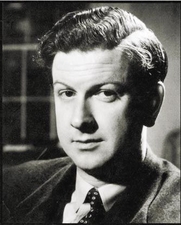
Edmund Crispin is the pseudonym of Robert Bruce Montgomery, known as Bruce Montgomery, who is remarkable because he achieved equal fame, under his own name and his pseudonym, in two different fields of creativity. As Bruce Montgomery, he was a popular composer and, as Edmund Crispin, an acclaimed writer of nine detective novels and two volumes of short stories.
Montgomery was born in Buckinghamshire in 1921, and educated at Merchant Taylors' School. As a child he had a congenital deformity of the feet and, up to the age of fourteen, he had to endure many operations and wear callipers to prevent his feet turning inwards. He graduated from St John's College, Oxford in 1943, having been for two years its organ scholar and choirmaster. He taught at Shrewsbury School from 1943 to 1945. His initial fame came as a composer of choral and vocal music, the best known of which is An Oxford Requiem (1951.) He then turned to film work and wrote the scores for many British comedies in the 1950s. He composed six scores for the Carry On series, including the original Carry On theme. In 1961 he was responsible for the screenplay and score of the comedy set in an elite music school, Raising the Wind. This film drew heavily on the casts of two popular comedy series of the time, the Carry On and the Doctor series, although it did not belong in either series.
From 1944 until 1953, as Edmund Crispin, he published eight detective novels and one collection of short stories. His literary output then dried up, although he still wrote reviews of books in the crime and science fiction genres for the Sunday Times. In 1977, just before his death, he completed and published a final crime novel, The Glimpses of the Moon. Crispin died in 1978, and in 1979 a short story collection, Fen Country, was published posthumously.
From 1953 onwards he produced little music or literary work, although he edited seven volumes entitled Best Science Fiction, which were published in the 1960s. He lived quietly in Devon, in poor health due to alcohol-related problems. In 1976, he married his secretary, Ann. He died two years later in 1978.
While studying at Oxford, Crispin read and admired detective stories; his particular heroes were John Dickson Carr and Michael Innes, and when he started to create his own detective fiction he adopted the name of one of the characters in Innes' novel, Hamlet, Revenge! As his pseudonym.
Crispin's detective is Gervase Fen, a professor of English at St Christopher's College, Oxford. This fictional college is located next to Crispin's own college, St John's. Fen's character is reputedly based on an eccentric Oxford professor, W.E. Moore. In the first of Crispin's detective novels, The Case of the Gilded Fly (1944) we encounter Gervase Fen as the train he is travelling on is delayed just outside Oxford: 'At no time a patient man, the delays drove him to distraction. He coughed and groaned and yawned and shuffled his feet and agitated his long, lanky body about in the corner where he sat. His cheerful, ruddy, clean-shaven face grew even ruddier than usual; his dark hair, sedulously plastered down with water, broke out into disaffected fragments towards the crown.' A few years later, his physical appearance has changed very little but we are given more information about his taste in clothes: 'His face was cheerful, ruddy and clean-shaven, with shrewd and humorous ice-blue eyes, and he had on a grey suit, a green tie embellished with mermaids, and an extraordinary hat.' (Love Lies Bleeding, 1948.)
Fen is in his early forties, a man of great academic distinction, boundless energy and insatiable curiosity about all manner of things. His passion is for detecting crime, just as the favourite hobby of his friend, Sir Richard Freeman, the Chief Constable of Oxford, is English literature.
Fen is never the romantic hero. If romance intrudes it is usually the province of a friend,colleague or former student of Fen. Gervase Fen is married to 'a plain, spectacled, sensible little woman, incongruously called Dolly', (The Case of the Gilded Fly 1944) who is not in the least perturbed by Fen's behaviour, as when an elderly, deaf colleague of Fen foists himself upon the company and demands whisky: 'Fen got it for him with painful reluctance, and contented himself henceforth with uttering in a penetrating whisper various slanders against the old man, to the acute embarrassment of everyone except Mrs Fen, who was apparently quite used to it and who said, “Now, Gervase!” in an objurgatory but automatic manner every few minutes.' (The Case of the Gilded Fly, 1944.) Fen's marriage is a happy, placid affair, which allows him to be on easy terms with attractive young women without taking the matter any further. 'She wore a light dress of plain black, with white collar and cuffs, which modelled her figure to perfection. Even Fen, who being comfortably married, had some time ago, more from a sense of wasted effort than from any moral scruples, given up looking at girls' figures, was manifestly impressed.' (Holy Disorders, 1945.)
Much of the information we get about Fen is thrown in, almost incidentally. We know he has children because, at one point, he is summoned back to an investigation when he is playing ball with his son. Also, when he feels his case has become becalmed, 'he went home and spent the remainder of the day eating, sleeping, reading, vilifying his children and practising desultorily on the French horn.' (Frequent Hearses, 1950.)
We discover that he served in the First World War because, when a villain tries to shoot at him and his companion, 'Fen, who had fought in the Great War, fell flat on his face, with well-drilled precision. Geoffrey, who had not, remained immobile, gaping in frank stupefaction.' (Holy Disorders, 1945.) That is all we are told about Fen's military service and we are given no information about his youth.
Fen is clever, vain and boastful; he makes a lot of fuss about an insect sting on his finger but when he is in real danger he is courageous, as when he is tied up and at the mercy of an enemy agent who: 'stepped forward and kicked Fen in the face.
After a minute: “That hurt,” said Fen mildly, “and you've knocked out one of my teeth.” He spat it on to the floor. “Why do you conspire against your country?”' (Holy Disorders, 1945.)
On another occasion, Fen and the young woman he is attempting to rescue are being stalked by by an enemy who intends to kill them and is holding a gun on them: '… it was held in a very steady hand – the shadows which it threw were motionless, with the sharp, unreal contours of shadows in a stage set. Of the figure behind it nothing could be seen except the slim, well-cared-for hand which held the revolver. Fen checked the instinct to flight, swiftly turning his back on the light to shield Brenda with his body. Futile enough, he knew; one bullet for him, one for her, and so an end.' (Love Lies Bleeding, 1948.)
A complex character, abrasive and often offensive, Fen is a staunch ally. '”Come on,” said Fen. “We're going to make a move now.”
He helped her to stand. She staggered, one arm around his neck. The raincoat dropped unregarded to the ground.
“All right?” he asked.
She gave a little gasping laugh. “I can manage.”
On an impulse, he kissed her gently on the forehead. “Bless you, my child,” he said lightly. “Now, as quietly as possible, and no talking, please.”' (Love Lies Bleeding, 1948.)
Fen's speech is frequently as eccentric as his manner. His favourite explanation is, '”Oh my dear paws!”' quoting the White Rabbit in Lewis Carroll's Alice in Wonderland.
The character that shares more of Fen's adventures than any other is his small, red sports car, Lily Christine III; a vehicle as eccentric and egocentric as Fen is himself. Lily Christine is an invaluable ally in the numerous comic chases that are scattered throughout Fen's adventures and can always be relied upon to help him to make an entrance that cannot be ignored.
In The Moving Toyshop (1946), Crispin treats us to a leisurely and beautiful description of morning in Oxford: 'Out of the grey light came a gold morning. The leaves were beginning to fall from the trees in the Parks and in St. Giles', but they still made a brave show of bronze and yellow and malt-brown... All over the city in colleges and belfries, the mechanism of clocks whirred, clanged and struck nine o'clock, in a maddening, jagged syncopation of conflicting tempo and timbre.'
And then, into the civilised scene: 'A red object shot down the Woodstock Road.
It was an extremely small, vociferous and battered sports car. Across its bonnet were scrawled in large white letters the words LILY CHRISTINE III. A steatopygic nude in chromium leaned forward at a dangerous angle from the radiator cap.'
Having turned into the private road leading to St Christopher's and narrowly missed demolishing the college buildings and the President, who had been standing looking out of his window, the car traverses the college grounds and, 'thundered across a strip of lawn, buried its nose in a large rhododendron bush, choked, stalled, and stopped.
Its driver got out and gazed at it with some severity. While he was doing this it backfired suddenly – a tremendous report, a backfire to end all backfires. He frowned, took a hammer from the back seat, opened the bonnet and hit something inside. Then he closed the bonnet again and resumed his seat. The engine started and the car went into reverse with a colossal jolt and began racing backwards towards the President's Lodging. The President, who had returned to the window and was gazing at this scene with a horrid fascination, retired again, with scarcely less haste than before. The driver looked over his shoulder and saw the President's Lodging towering above him, like a liner above a motor boat. Without hesitation, he changed into forward gear. The car uttered a terrible shriek, shuddered like a man smitten with the ague , and stopped; after a moment it emitted its inexplicable, valedictory backfire.'
This is one of the most the glorious things about Crispin's novels; they are funny on several different levels from sophisticated satire to slapstick farce, worthy of the Carry On films that Crispin had been involved in as a composer.
The plots that Gervase Fen tackles are complex and quite often fantastic, although always intelligent. This is because Crispin is fond of the locked room mystery and, having created an apparently impossible crime, he has to find a way out of it.
The character of Fen is a delight, whether he is working at his 'proper' job as a Professor of English or straying into whatever new career his restless imagination takes him. In Buried For Pleasure, (1948) he decides to stand for Parliament, (inevitably as an Independent candidate) and proves to be a remarkably fluent and persuasive speaker, until he decides that he would hate being an MP. At this point he gives a final speech telling his prospective constituents what he thinks of them. 'Fen got to his feet and stood for a moment surveying the rows of politely expectant faces below him with a satisfaction that he had not experienced in his whole lifetime. And the survey completed, the banquet of consternation savoured in anticipation, he removed the safety pin of his grenade. “It is often asserted,” he said, “that the English are unique amongst the nations for their good sense in political matters. In actual fact, however, the English have no more political good sense than so many polar bears. This I have proved in my own person. For some days past I have been regaling this electorate with projects and ideas so incomparably idiotic as to be, I flatter myself, something of a tour de force.”... “Such dreary fallacies as these, expounded by myself, have been swallowed hook, line and sinker.” (Buried For Pleasure, 1948.)
Imagine Fen's dismay when, despite this tirade, he wins by one vote. Fortunately an error on the part of his agent allows him to escape his parliamentary fate.
The pervading feeling of the fantastic is not just in Crispin's plots it is also in Fen's character and actions, as when let loose in a murdered opera singer's dressing room. 'Fen had been standing in front of the mirror, painting a large black moustache on his face. He now turned and exhibited the result. Elizabeth uttered a little squeal of delight. Fen frowned at her.' And, a little later, '”This becomes interesting,” said Fen. He had applied removing cream to his upper lip, and now looked as if he had been eating blancmange.' And yet, a few moments later, 'Fen had stopped fidgeting, and was sitting on the edge of the dressing-table, his blue eyes intent, his usual fantastic naivety for the moment in abeyance.' (Swan Song, 1947.)
Crispin's use of language is remarkable in that he can combine humour with wonderfully precise description. He conjures up images with a few words: 'And in the midst of them stood the Inspector, like a minor devil enumerating the canons of hell to a coven of particularly obtuse witches.' (Swan Song, 1947.) At the same time he has a great deal of fun, reminding readers that Fen is a fictional character. '”Professor Fen” - Elizabeth adopted her most politic charm – would you be prepared to let me interview you for a newspaper?”
Fen made a feeble attempt to show disinclination. “Oh, I don't know,” he mumbled.
“Please, Professor Fen. It's in a series. I'm hoping to do H.M., and Mrs Bradley, and Albert Campion, and all sorts of famous people.”' (Swan Song, 1947.)
In Holy Disorders Fen is disgruntled when Scotland Yard is going to be brought in, although he grudgingly admits that Appleby (Michael Innes' iconic, fictional detective) is good at his job. Unfortunately Appleby is not the detective that arrives to solve the case but some very inferior policemen. A Fen and Appleby book would have been truly wonderful.
In The Moving Toyshop, when Fen and his companion are overpowered and tied up, Fen whiles away the time in the following unique manner: '”Fen steps in,” said Fen. “The return of Fen. A Don Dares Death (A Gervase Fen Story).”
Cadogan moaned and opened his eyes... “Murder stalks the University,” said Fen. “The Blood on the Mortarboard. Fen Strikes Back.”
“What's that you're saying?” Cadogan asked in a faint, rather gurgling voice.
“My dear fellow, are you all right? I was making up titles for Crispin.”'
And, (in the same book) referring to his 1940s publisher's political inclinations, during a chase scene when they come to a fork in the road, '”Let's go left,” Cadogan suggested. “After all, Gollancz is publishing this book.”
The action of the Gervase Fen novels is set in the early 1940s, either during the Second World War or a few years after the War. Although the stories are set in the time of Crispin's years as a student at Oxford University, he has created a character twenty years older than himself who is a professor not a student; a character that has the prestige, connections and confidence to insert himself into numerous investigations. Real life characters, such as Philip Larkin and C.S.Lewis appear 'off stage' in the books and The Moving Toyshop is dedicated to Larkin, who was a friend of Crispin.
Amongst the likes that Crispin listed in early editions of his books are Wagner and Shakespeare and these interests are also obvious in Gervase Fen. The crime in Swan Song (1947) is set against the background of the first production of Wagner's Die Meistersinger to be produced in Britain since the Second World War and Fen's first arrival upon the scene is with the following complaint: '”It argues a certain poverty of imagination,” said Gervase Fen with profound disgust, “that in a world where atom physicists walk the streets unharmed, emitting their habitual wails about the misuse of science by politicians, a murderer can find a no more deserving victim than some unfortunate opera singer.”'
Crispin also states that he dislikes dogs and this is equally evident. The unfortunate canines that appear in his books inevitably meet a heroic but violent end. The non-doing pig, unattractive but obsessively faithful, also fares badly at Crispin's hands. However, Crispin does like cats, as is obvious in his portrayal of Lavender, the cat who sees Martians in The Long Divorce (1952.)
Crispin takes places and experiences that he is familiar with and makes them his own. Indeed, in more than one book, he tends to dwell on the difficulties and delays of train travel into Oxford. In many books the background is wartime and post-war Oxford, where theatrical performances inevitably lead to death, as in The Case of the Gilded Fly and Swan Song. He also knows life in small villages and produces cameo sketches of wonderfully eccentric locals, as in Holy Disorders, Love Lies Bleeding, Buried for Pleasure and The Long Divorce. He uses his knowledge of being a first class organist and composer to create the character of Geoffrey in Holy Disorders, which also uses his knowledge of the High Anglican Church. His memories of teaching at a private school form the background in Love Lies Bleeding. In Frequent Hearses his experience of film studios form the background for the novel, and, as always, Crispin is happy to mock himself as well as others. 'She put down the instrument. “A composer,” she explained soberly, like one who refers to some necessary but unromantic bodily function.'
Crispin is a remarkable writer who combines elegant description, witty observation, eccentric characters and sudden moments of sheer comedy, and places it within a plot of intriguing if often fantastic complexity. He can also write incredibly tense drama: the plight of Judy, lost in a maze on a dark, wet night, alone and painfully aware that a murderer is very close at hand is truly terrifying. (Frequent Hearses 1950.)
Crispin breaks all the rules and pulls it off, apparently without effort: author viewpoint slides through the novels so smoothly it cannot be considered an intrusion and Fen frequently makes humorous, mildly critical observations about his 'author.' Fen is an engaging character, a man of insight, intelligence and humour, and one who does change and grow: '”As I get older,” he explained, “I get less resilient and more predictable. It depresses me sometimes.”' (Frequent Hearses, 1950.) However, the essence of the Gervase Fen novels is their comic presence, as observed in the New York Times: 'Crispin is noted for an ability to embellish clever storylines with Marx Brothers touches.'

The Gervase Fen novels were originally published by Gollancz.
Many are now back in print, published by Vintage Books.

Wednesday, 14 May 2014

Writing 'About the Children'


'Where do you get the ideas for your books?' 'How do you start?' I've been asked these questions frequently, especially by my Creative Writing students, and they are tricky questions to answer. The starting points are so varied and so hard to pinpoint; not to mention that the starting point of the book in First Draught can often be moved further back in the editing process or even be eliminated altogether.
In About the Children, the first inspiration came to me in Paris, in a garden near the Seine, where I saw a young couple kissing on a bench. The girl was kneeling, straddling her partner, and it was only when they moved apart that I realised that they were both women. A little while later, a different girl walked past me, wearing jewelled tear-drop make-up. The two images combined and (after a period of thinking 'nice little scene, what are you going to do with it?') they became Sophie and Colleen, embracing in a suburban English park. In the first draught, the book opened before the shootings and there were two chapters of description leading up to the deaths. There was some nice descriptive writing in there but I'm pretty certain that, if it had stayed, I'd have lost 75% of my readers before the first shots were fired. I realised that I'd been using the first few chapters to write myself into the book, and that was fine. Some people plot meticulously, I go with the flow of the writing. Sometimes I hit the right starting point at the first shot, sometimes not.
Talking of shots, let's get back to About the Children. I found myself with an opening scene of two children shot in a suburban park. 'The two boys lay sprawled and broken, like fledglings that had fallen from the nest.' The moment I wrote those words I knew that they were right and they haven't changed, whatever else has.
And who was the Senior Investigating Officer looking down on them? His name came quite easily... Tyler... Kev Tyler, usually referred to by his surname and only ever called Kevin by his ex-wife and his mother. Everything I knew about Tyler could be summed up in two words: 'intelligence' and 'integrity'. I soon discovered other features: his ambition and single-mindedness; his love of good literature, which he kept concealed from his colleagues; his deeply hidden, basic insecurity. One thing I was certain of: Tyler's personal life was empty but he wasn't going to destroy all he had achieved by going off the rails.
Tyler's instinct to recall lines of poetry when he is under stress was great fun to write. What better excuse to read through lots of well-loved poetry books? However, I had to tread carefully, that sort of quirk can become irritating or farcical if over-used. In the end, I chose all long-dead poets. With the short quotes I was using I should have been okay but the last thing an Indie writer (or any writer) needs is to fall foul of copyright laws.
Detective Inspector Gill Martin, Tyler's temporary second-in-command, was harder to get to know than Tyler. Possibly she stood in his shadow, or maybe because she's a private person who didn't wish to be known. However, as soon as I got inside her head, she was very easy to write.
The rest of the team were fun to write, especially Detective Sergeant Kerry Buller, loud and opinionated and always one step ahead of everybody else with the gossip. Detective Sergeant Luke Warden was even easier to write. While Tyler was in the US (before the start of About the Children) he'd been seconded to another team and joined Scene of Crimes Officer Mia Trent to play a part in an investigation in a nearby town, which is told in The Terminal Velocity of Cats.
For several draughts of About the Children I had an insertion between every chapter, which told the story in the First Person Viewpoint of other characters. In many ways it worked: I certainly got to know my minor characters and their motivation very well; but it slowed down the pace, and possibly gave too much away. I removed all the central inserts but left the beginning and end ones as a very short prologue and epilogue, because I felt it was essential the disempowered children had a voice.
Titles are very important to me and I struggled for a long time with the title for this book. The story addresses the deepest fear any parent can have and I drew my fundamental, emotional inspiration from The Death of Children, Richard Burns' harrowing poem about the holocaust. In the end I heard Tom Paxton singing a song about divorce, with the chorus, 'No worries any more about the children.' I thought, 'Of course, that's the central theme of this book, it's About the Children.'
I absolutely love the cover, designed for the book by my colleague, Chris Hammacott of the Art of Communication. We'd already agreed that all my contemporary crime would have a yellow Crime Scene tape across them to set the brand. I gave Chris a very out-of-focus picture of a child walking away and said, 'Sort of like that, please.' She found a much better picture of a younger child and worked her magic with colour and style. It's such a joy to have covers that I can feel proud of and I love it when people stop and comment on them because they're so eye-catching.  

Check out this great review of About the Children


Check out this great review of my latest Police Procedural, About the Children, by Lizzie Hayes, the founder and editor-in-chief of Mystery People, the ezine that everybody who loves reading and writing crime fiction should subscribe to.
http://www.mysterypeople.co.uk/
http://promotingcrime.blogspot.co.uk/


About The Children
by Carol Westron

The discovery of two boys shot dead, both under the age of twelve in a quiet suburban park
is a gruelling find. Assigned to the case is Superintendent Tyler head of Saltern's Serious
Crimes Team, and with his regular second-in-command on sick leave his new DI is Gill
Martin. There are however five victims, three dead; a woman and the two children, and two
wounded, a man and a young woman. As the SOCO team proceed to sift the evidence it be-
comes a possibility that there were three children present at the time of the attack, and if so
where is the third child?
Whilst his team try to establish the train of events, such as who was shot first, Tyler, Gill
Martin and his Sergeant Kerry Buller visit the parents. Jasmin and Ian Quantrull confirm that
their youngest child Charlie had gone to the park with his two brothers.
As Tyler and his team investigate the lives of the five victims, trying to establish a motive, the questions abound . Were these random killings? Who were the intended victims? But the overriding urgency is ‘Where is Charlie’
As complicated as is his job, so to is Tyler. Having recently returned from a course in the USA on children who commit violent acts Tyler reluctantly begins to look at the two boys . An avid reader Tyler has a habit of finding passages from books leaping into his mind as he goes about his job. Something that helps him make sense of the ugliness he so regularly encounters, but which he keeps locked away from his colleagues. It will be interesting to learn more of Tyler. And also of Gill Martin.
Complex and compelling this is a fascinating mystery and even as the layers of the lives of both victims and family members are stripped away, as the investigation progresses you will still be eagerly turning the pages to know the identity of the killer. A marvelous second book, I look forward to the next. Most highly recommended.
------
Reviewer: Lizzie Hayes

About the Children is published by Pentangle Press, April 2014.
ISBN: 978-1-4952-32107-7
www.carolwestron.com

Sunday, 13 April 2014

It's Too Tricky On My Own. Why Adam needs a very special dog.


This is very different from my usual writing blogs, not to mention a great deal longer. However those of you who know me personally will know it is a subject very close to my heart. My thanks to R.J. Scott for inviting me to take part in her regular April Autism blog hop and apologies for late delivery, my Internet connection went down until an hour ago.


Adam will soon be eleven but he's never been anywhere without an adult to look after him: not even to the shops or the local park with his thirteen-year-old brother. He cannot play in the garden without somebody within sight. He's too anxious to go anywhere alone and, even when he's with an adult, when he gets scared he can run into danger, blinded by panic.
Adam has autism. He was diagnosed when he was three. It's as if he went into the 'terrible twos', got lost in a maze of dark tunnels and couldn't find his way out. At that time his fear was uncontrollable and he would try to run away wherever he was; hide and not respond to his name while people searched for him. He'd kick, hit and bite when people who loved him tried to restrain him to keep him safe. It could take half an hour to get him in the car to drive his brother to school. He had no speech and seemed unaware of the people around him, climbing over them as if they were furniture.
Adam was born in the late summer, which meant he had to enter school when he was four years and one month old. There was no way he was ready and, because of his non-compliance, the Local Authority wanted to send him to a school that was not, in our opinion, in any way right for him. We took the Local Authority to Tribunal to fight for Adi's right to one-to-one support in a mainstream school. It was an expensive, harrowing experience, which we won. The problem was that we'd won the War but we lost the Peace. The class teacher's attitude was so negative and the one-to-one supplied was so inadequate that we knew he wouldn't be safe and he certainly wasn't happy. My daughter and I both taught in local Further Education Colleges, so we decided to cut our hours and educate Adam at home. We were lucky to have the help of a wonderful Occupational Therapist who specialises in Sensory Integration but, at that early point in her career, was willing to be part of Adam's Home Education Team. Apart from that, if something we needed wasn't available we created it for ourselves. We set up Primetime, the Home Education group whose whole ethos was based on disabled and mainstream children mixing and playing and learning respect for each other.
We have a mix-and-match approach to Adam's education; working on instinct a lot of the time.
It hasn't been easy. In fact most of the time it has been a long, hard grind, especially for Adam's mum, who for several years survived on two to three hours sleep every night, because Adam woke and prowled the house. The gluten and dairy free diet he's on has made a lot of difference to Adam's well-being, but it complicates life and it costs a lot.
But it is all worth it.
At ten-years-old, Adam is lively, talkative and funny, and one of the most loving little boys in the world. He is starting to read, his maths is pretty good and he loves drawing. He goes out to various Home Education clubs where he meets friends and is learning to play, but always with his mum close at hand. He doesn't bite or kick and tries very hard not to hit, although sometimes 'my hand does it before my head can say no.' He frequently tells the people in his life how much he loves them and melts our hearts by asking for help and explaining, 'It's too tricky on my own.' One problem that's current is that Adam gets lonely and scared at night and creeps into his mum's bed. He's still a young and very innocent child but, in the near future, this has to be sorted out.
Adam loves animals. He adores the family cat, Tails, and helps look after the two naughty rabbits, Bobby and Endy. He was desolate when his dog, Rolo, died of cancer a year ago, and still speaks of him often, taking comfort in the thought that Rolo's back doesn't hurt him any more and he's in Heaven 'dancing with Michael Jackson.'
Adam's life is much better than anyone ever expected, but he needs something else, he needs a friend who is there all the time to play with and keep him company in the garden, and who, in time, can help him achieve the independence of going out alone. He needs a very special dog with special training to help fill the gaps in Adam's life. In the summer Adam will get his very special Golden Retriever, fully trained to help with his needs and allowed to go with him anywhere that a Guide Dog would go: shops, restaurants; cinema; bowling; the beach; all the many places where Adam finds it 'too tricky on his own.'
So what will this dog do?
He'll keep Adam company, lying beside his bed, at night, and help him to stay in his own room. He'll be out in the garden with him when he's on the swing or playing, which will give Adam more independence and a playmate who's devoted to him.
When out and about the dog's lead will be attached to Adam's wrist and if he runs in panic the dog will circle him, anchoring him down, until the adult with Adam can intervene.
The dog will be trained to sense Adam's mood and, when he senses that Adam is getting agitated he'll gently paw him to distract him before Adam has a 'meltdown.'
He'll be a companion and a friend, who never withdraws his love and is always there ready for a game and up for a trip to the park or beach.
He'll give Adam the confidence to face new experiences without being overwhelmed by anxiety and the dog will have his own passport for travelling abroad... Jet set dog!
In time he may be able to accompany Adam to the park or shops without a carer. That will be the ultimate in independence.
This perfect dog will even be trained not to chase the cat or rabbits.
Service Dogs Europe train the autism dogs and puppies to an amazing standard. Check out their Facebook Page to see some of the cutest pictures in the world. But there's one problem, Adam's Golden Retriever friend, companion and guardian will cost £4,000. So we are fund-raising in every way we can, car boot sales, soft toy stalls, e bay sales, an e-published short story anthology and a sponsored dog walk.
Adam wants to play his part and has illustrated a story I wrote for him, in his own unique style. Those who know about autism, and those of you who are authors, will know what an amazing achievement that collaboration was. Adam's improved version has more trains in it than the original,  but he understood the need for the Dream Train and Adi to go through the darkness alone, although it cost him an effort to draw it. One of my favourite moments was when I asked him if he knew how to draw dragons and he said, 'Of course, Grandma. Coming right up,' and drew Chinese Dragons. Genius!
Adi and the Dream Train is available to buy from Amazon but the way we'd prefer everybody to buy, to maximise the profits for Adam's dog, would be for anybody who'd like to support us to go to http://www.mycharity.ie/event/jo_halsalls_event/
If you pay £10 or more and would like a copy of Adam's book, contact me on carolwestron@gmail.com and send me your address and I'll send one out to you.
All profits from the book will go to Adam's Yellow Dog Fund. Thank you for your support.

Thank you for staying with me through the longest ever blog. As you'll have guessed, my competition is animal related. I'd like you to send a brief account of how an animal has influenced your own life or that of somebody close to you. I'll ask Adam and his his mum and brother to help me choose the winner, who will receive a £6 ($10) Amazon gift voucher.