Wednesday, 26 August 2015

Mavis Doriel Hay


Mavis Doriel Hay is rather a mystery herself. The chief question being why did she write three detective stories in three years and then quit?
Remarkably little is known about Hay and I could find no pictures of her, which is strange when one considers that she was a contemporary of Dorothy L. Sayers and received an education that, in some respects, ran parallel to that of Sayers.
Hay was born  in Potters Bar, Middlesex (North London) in 1894, into a middle-class family, who were clearly willing and able to encourage their daughter to achieve an education that was unusual for a woman at that time. Hay was a student at St Hilda's College, Oxford, from 1913 until 1916 and Sayers was at Somerville, Oxford, from 1912-1915. Neither Hay nor Sayers would have graduated with degrees, because women were not permitted to be members of the university until 1920, when they were at last allowed to claim the degrees thatthey had earned.
After her time at St Hilda's, Hay seems to have returned to her primary love, the study and practise of rural crafts and, in 1927, she and her co-author, Helen Fitzrandolph published a wide-ranging and authoritative work, Rural Industries of England and Wales.
Hay was part of the generation of women who had lived through the tragic losses of the First World War. Hay had lost one of her brothers at the Battle of Jutland, in 1916. These young women had also seen their hopes of marriages decimated by the loss of young men in the War, but, in 1929, when she was thirty-five, Hay married Helen Fitzrandolph's brother, Archibald Menzies Fitzrandolph, a member of a wealthy and influential Canadian family.
It was during the years of her marriage to Archibald Fitzrandolph that Hay wrote and published three detective novels, Murder Underground (1934), Death on the Cherwell (1935) and The Santa Klaus Murder (1936). Hay's detective novels seem to have been well received. Indeed Dorothy L. Sayers wrote an encouraging review of Murder Underground in the Sunday Times in 1934: 'This detective novel is much more than interesting. The numerous characters are well differentiated, and include one of the most feckless, exasperating and lifelike literary men that ever confused a trail.'
In 1939 the Second World War broke out and Hay again suffered grievous loss. In 1939 her youngest brother was killed when his Tiger Moth crashed in the Malayan jungle and in 1940 she lost another brother, who died after being captured by the Japanese. Hay's husband, Archibald, had joined the RAF and was killed in a flying accident in 1943.
In 1921, The Rural Industries Bureau (RIB) was established by the Ministry of Agriculture. The purpose of the RIB was to develop rural industries by providing technical advice and assistance to country workshops. As well as various booklets and reports, it published a quarterly magazine, Rural Industries. This was an ideal very close to Hay's heart and she took up a position as a researcher for the RIB. The rest of Hay's life was devoted to her first love, the promotion of rural crafts. Under her married name, Mavis Fitzrandolph, Hay wrote and published many books about rural crafts, including 30 Crafts, written for the Women's Institute. She wrote numerous books about her passion, quilting, and won great respect for her work in developing the Welsh quilting industry.
Hay made her home in Gloucestershire and died in 1979, at the age of eighty-five. Her last book, Quilting was published in 1972. She showed no obvious desire to return to writing detective fiction.
To all appearances, despite the terrible losses that Hay suffered in the two World Wars, she went on to have a long and fulfilled life doing work that she loved. However, I am intrigued by the question of why Hay wrote three detective novels in three years and then abandoned crime writing.
While none of her crime novels can claim to be profound or ground-breaking, all three of them are pleasant and enjoyable reads, especially to lovers of the Golden Age, who are used to the language and manners of the 1920s and 1930s.
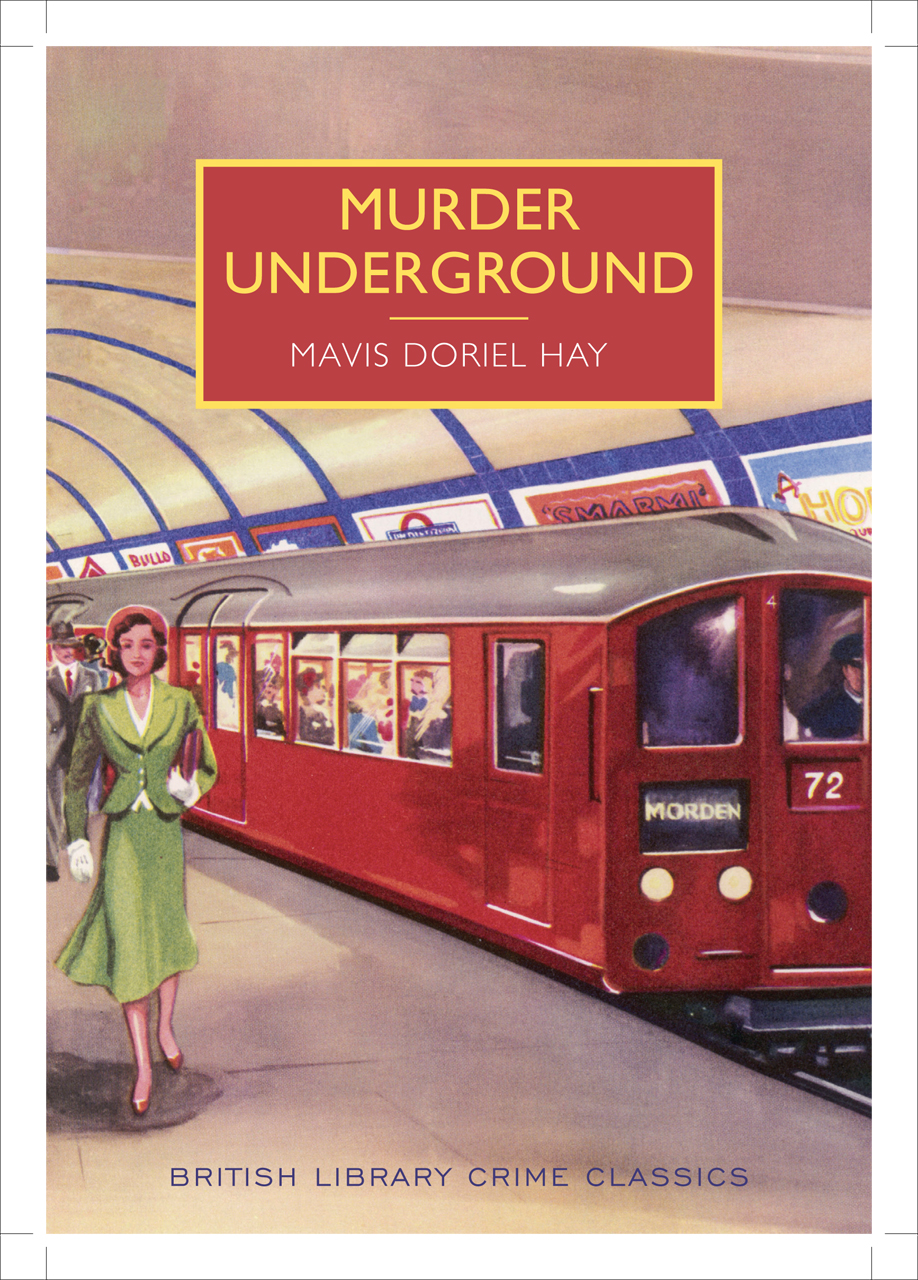
Murder Underground (1934) opens with the inhabitants of the Frampton Private Hotel, (which is, in reality a very ordinary boarding house) departing about their daily business. Amongst them is Miss Euphemia Pongleton, who 'pottered fussily out, hugging an enormous handbag and looking perhaps rather shabbier and more-out-of-date than usual.' When Betty Watson, another resident at the hotel informs her that it was a 'nice morning' Miss Pongleton 'wrinkled her nose as if she didn't like the smell of it.' This beautiful piece of characterisation tells us a great deal about Miss Pongleton. Despite her shabby appearance and parsimonious ways, Miss Pongleton is an affluent woman; she is also a very unpleasant, interfering person, who is fond of exerting power over other people. When she is discovered on the stairs of Belsize Park Station strangled by the lead belonging to her dog, Tuppy, her fellow residents are shocked but not distressed. Indeed, even Tuppy seems indifferent to his mistress' death. Most of the residents enjoy speculating about the crime, especially Mrs Daymer the novelist, but Betty Watson has more reason to care than most, as she is in love with Miss Pongleton's nephew, and probable heir, Basil Pongleton.
The police have several suspects. Chief amongst them is a young railway worker whose girlfriend works at the Frampton Hotel. Miss Pongleton had found out about a foolish, illegal act this young man had committed, and it is not clear whether she intended to report him to the police. However, the police also have good reason to suspect those who might benefit financially from Miss Pongleton's death: her nephew Basil and his cousin, Beryl. Although Beryl was not in the vicinity when Miss Pongleton died, her fiancé, Gerry, admits to passing the old lady on the stairs, presumably minutes before her murder. Miss Pongleton was in the habit of altering her will whenever Basil annoyed her. As Basil is the 'feckless, exasperating' literary man referred to in Sayer's review,  this occurs with unfortunate regularity and leads to a confusing abundance of contradictory wills. Basil's foolish and inconsistent lies mean that he is soon suspected of his aunt's murder. His behaviour is very self-incriminating, especially when he convinces his cousin, Beryl, and his girlfriend, Betty, to cover for his indiscretions. This leads the unfortunate Inspector Caird to speculate that Miss Pongleton's murder was committed by a 'gang' of her relations and fellow residents.
For much of the book Inspector Caird has very little time on-stage. While he is conducting interviews in one room of the hotel, the reader is hearing about it second-hand, through the discussion and speculation of the other residents. Near the end of the book he emerges as a sensible, conscientious officer, who feels angry that the idiotic and selfish antics of Basil Pongleton have led a nice girl like Betty into trouble. However this is a book of amateur detectives and it is they who solve the crime.
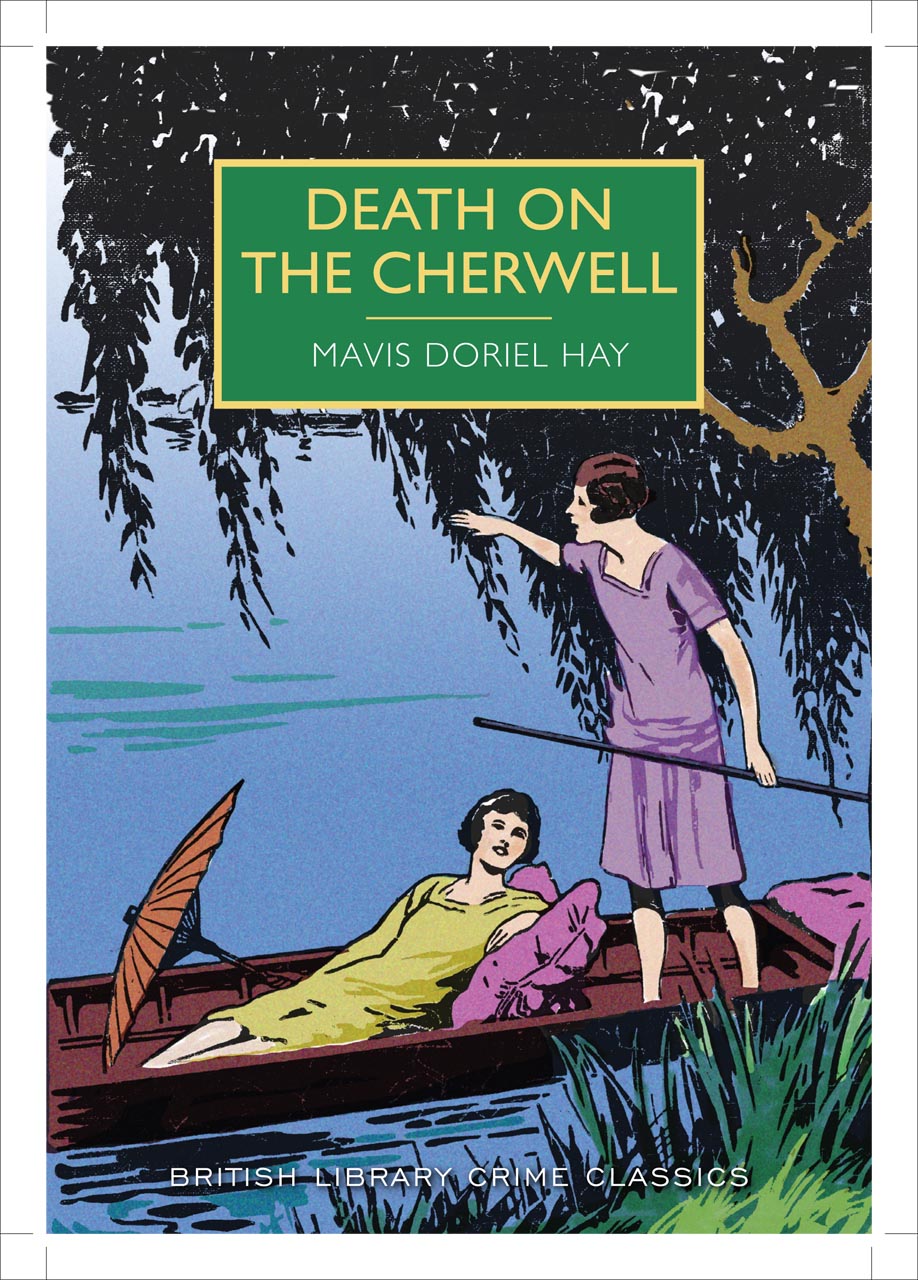
Death on the Cherwell (1935) is set in Persephone College, Oxford. This fictional woman's college seems to be modelled on St Hilda's, where Hay was educated. The book opens with the death of the unpopular college bursar and follows the investigation into her death. It is presumably a coincidence that Death on the Cherwell was published in the same year as Dorothy L. Sayers' Gaudy Night. The two books have some things in common: both are set in fictional women's colleges and both address the still debated question of women's education and the necessity for women students to behave with impeccable propriety, very different from the standards required for young men. Another interesting common factor is that both Sayers and Hay object to the condescending term 'undergraduettes' which was favoured by newspaper reporters of the time. As Miss Cordell, Principal of Persephone College reflects, 'Respectable publicity was bad enough because newspaper reporters, however carefully instructed, were liable to break out into some idiocy about “undergraduettes” or “academic caps coquettishly set on golden curls.” But shameful publicity! A death mystery! This was terrible!'
In other ways Death on the Cherwell and Gaudy Night are very different. In Gaudy Night, although there is some interaction with undergraduates, the main action is set amongst the middle-aged dons. It is a novel from the viewpoint of adults. There are times when Death on the Cherwell strongly resembles a girls' adventure story. The action opens with a group of Persephone College first year undergraduates gathered together at the boat house to form a society to curse their unpopular bursar, Miss Denning. Imagine their horror when, a few minutes later, Miss Denning's canoe drifts up to the landing stage, with Miss Denning dead inside it, soaking wet, apparently drowned in her canoe. The girls decide to investigate. They are led by Sally Watson, sister of Betty Watson, who featured in Murder Underground. Betty and Basil also appear in this book, and it is a relief to see that Betty has become more assertive and Basil has grown up.
In this book the reader is allowed to follow the police investigation at first hand. On the first evening, the local inspector, Inspector Wythe, interviews the witnesses and is more impressed with Sally than she is with him: 'Trim and self-controlled she looked now, although her usual buoyant self-confidence had not quite returned. She had sleeked her brown hair and had donned – hastily, yet with a vague sense of fitting herself for a sombre occasion – a tailored, navy-blue frock. A nice sensible girl, thought the inspector, as he looked directly into her brown eyes.
Rather a stupid-looking man, thought Sally, after a brief inspection of his square, stolid face and reddish, toothbrush moustache.'
The local police are soon aided by Scotland Yard, in the person of Detective Inspector Braydon. Braydon proves to be an intelligent, hard-working and capable officer and it is not his fault that the rules of this style of detective fiction prevent him from being the one who solves the case. That honour, of course, is reserved for the amateur sleuths.
With Murder Underground and Death on the Cherwell it seems that Hay had established her detective fiction style. This includes the murder of an unpleasant victim, which means that nobody really cares that she is dead and also means that there is a large number of potential killers to choose from. Those solving the crime include reasonably intelligent and hard-working police detectives who are always one step behind the motley band of enthusiastic amateurs. The story is set in a limited community, such as a private hotel or university college; it is told in the Third Person, Past Tense, and includes some lively, often flippant dialogue and well-observed, skilful descriptions.
In Hay's third book, The Santa Klaus Murder, the victim is Sir Osmond Melbury, a tyrannical patriarch who bullies his family into submission by threats of cutting them out of his will. Sir Osmond has purchased a Santa Claus suit and persuaded one of the guests to wear it and give out presents on Christmas Day. Sir Osmond's controlling manner extends even to the pronunciation of the character's name: 'I knew Sir Osmond was particular about us saying Santa Klaus; said we gave it up in the War, because it was German, but we oughtn't to mind now and Father Christmas was just silly.' As in Hay's previous books, the victim is unpleasant and many people wish him dead, and the setting is the closed community of a country house at Christmas. However the style of this book is very different from its predecessors. Approximately the first 20% of the book is occupied by First Person narrative accounts from five people who were in the house when the murder was committed and describe the days leading up to the murder. Much of the rest of the book is in the First Person narrative of Colonel Halstock, the Chief Constable, although there are two later chapters in other characters' viewpoints. One of these viewpoints is that of Kenneth Stour, an actor who has recently returned from a triumphant tour abroad, who is allowed to insert himself into the investigation. Colonel Halstock indicates that Stour is a talented amateur detective who has been of use to the police before in investigations. Again the amateur detectives solve the case just ahead of the official investigators.
In my opinion, the style of The Santa Klaus Murder does not work as well as Hay's earlier books. When Wilkie Collins used 'witness statement' narratives in The Moonstone (1868) the reader knew what was happening from the beginning and the different narrating voices were clearly differentiated. In The Santa Klaus Murder it is easy to get muddled between narrators and it is not clearly explained why these people are giving these accounts, although matters improve when Colonel Halstock takes the main part of the narrative.
Hay's books are always an ensemble act, with amateur detectives emerging all over the place. Perhaps one of the reasons she did not continue writing detective fiction was that she could not decide what sort of detective she wished to spend her mystery writing career with, although there are several options. Betty, Sally and Basil would have made an enterprising and amusing detective trio. Suave, experienced Kenneth Stour could have been developed into an excellent series detective. However, my vote would have gone to the eccentric and irritating novelist Mrs Daymer from Murder Underground. Towards the end of the book, two sets of amateurs hit upon the truth at the same moment but it is Mrs Daymer who has the wit to spot an insignificant clue that is too nebulous to take to the police, and also has the determination to follow it up and collect the evidence: 'The implication which she saw in this discoloured record of an unimportant case of thirty years ago was so horrible and so fantastic that she could not bring herself to name the man whom it seemed to point to.' It is possible, if Hay had wanted to develop her, Mrs Daymer might have made a detective to rival Gladys Mitchell's Mrs Bradley.
Of course, all this is irrelevant, because Hay never created a series detective or a series of detective stories. One can only speculate on Hay's reasons for abandoning detective fiction after such a short career, although it seems clear that she had a fulfilling career in the field of crafts that had been her first love. Now a new generation of readers have the chance to enjoy her books thanks to the British Library's policy of republishing almost forgotten authors. This is very good news indeed and Hay's books are well worth reading, especially for lovers of Golden Age mysteries.

Published by the British Library:
Murder Underground, ISBN: 978-0-7123-5726-5
Death on the Cherwell: ISBN: 978-0-7123-5712-8
The Santa Klaus Murder: ISBN: 978-0-7123-5712-8


Monday, 13 July 2015

Rule Makers and Rule Breakers of the Golden Age

A.A. Milne
S.S. Van Dine
Ronald Knox
Agatha Christie
Dorothy L. Sayers
This article is written from research done for the paper I delivered at Bath Spa University Crime Writing Conference. Captivating Crime 2: Traditions and Transgressions.
WARNING: This article contains some spoilers.

When we speak of the Golden Age of crime fiction the first names that come to mind are Agatha Christie and Dorothy L Sayers, closely followed by Ngaio Marsh, Margery Allingham and Josephine Tey. In the late 1920s Christie and Sayers were both well into their detective fiction careers, but they were not the writers who decided to set down a list of rules for the genre. Of course, the position of women was very different  then it wasn't until 1928 that all women in Britain were allowed to vote, and in 1918, when the first law was passed to enfranchise some women, neither Christie nor Sayers were old enough to vote. My instinct is that neither woman would let the expectations of society prevent them from doing what they wanted, certainly not Sayers, with her strong Feminist principles. Perhaps it was simply that they were too busy writing and stretching the boundaries of the genre to bother about formulating rules.
So who were the men who felt themselves uniquely fitted to the challenge of creating a set of rules for writing crime fiction? Who else could it be but a Roman Catholic priest and an American art critic?
However, they were not the first. In 1922 AA Milne had published his only detective story, The Red House Mystery, and, in the 1926 edition he included a foreword that laid out, with his characteristic humour, the things he felt essential for a detective story.
1. The use of straightforward language.
2. Clues to be revealed throughout the book not kept to the last chapter.
3. To do this he advocated the use of a Watson figure, so that clues should be presented in accessible dialogue form.
4. Milne also preferred no love interest in detection books, because he felt romance detracted from the business in hand.

In 1928 a group of mystery writers came together and formed what, a couple of years later, became known as the Detection Club. One of the members, Ronald Knox, created ten rules of detective fiction, which he ironically called the Ten Commandments. Knox was a brilliant scholar who converted to Roman Catholicism and became a priest. As well as being an eminent theologian, he wrote essays, pastiches, and broadcast on numerous radio programmes.
Knox had a dry, sense of humour and an unfortunate lack of appreciation of the fact that other people didn't always realise when he was joking. In 1926 he made a radio broadcast entitled Broadcasting From the Barricades, which described a scene in which London was being destroyed by a rampaging mob and a Government Minister was hanged from a lamp-post. It should have been clear that this was a spoof: it was announced at the beginning, the names were absurd and so were the government departments, but many people tuning in slightly early for the following programme were alarmed. After all, the BBC was not expected to make jokes and it was earlier in the year of civil unrest that led to the General Strike. And it was only a few years after the First World War, and many people were attuned to expecting loss. Knox's recording career was tarnished by this practical joke.
Knox was also hoist by his own petard when in 1911, he delivered a satiric lecture, followed by an essay: Studies in the Literature of Sherlock Holmes which claimed that Holmes had really died at the Reichenbach Falls and the later stories were the fabrications of an alcoholic and delusional Watson. From that time Knox was regarded as an expert on Holmes and continually appealed to for essays and talks. In The Life of the Right Reverend Ronald Knox (1959) Evelyn Waugh reports Knox's response to one such request: 'I can't BEAR books about Sherlock Holmes. It is so depressing that my one permanent achievement is to have started a bad joke.'
In 1925, Knox started writing detective novels in an attempt to increase his income. In 1927 he introduced his series character, Miles Bredon, an investigator for the Indescribable Insurance Company.
It is generally accepted that Knox had no intention of his Ten Commandments being carved in stone. They show the humour and intelligence typical of Knox, mocking many of the crime writing clichés of the time, such as an over-abundance of secret passages, identical twins, supernatural agencies and unknown poisons.
Despite his rejection of Holmes and Watson, he agrees with Milne about the value of a Watson-like figure.
His rejection of the use of Chinamen is especially interesting. The Yellow Peril was over-used in crime fiction at this time but he is also making a serious social point. As the historian Julia Lovell wrote in 2014: 'In the early decades of the 20th century, Britain buzzed with Sinophobia. Respectable middle-class magazines, tabloids and comics alike spread stories of ruthless Chinese ambitions to destroy the west.'
Knox does keep his own commandments, although I think he may fall into Temptation when it comes to number ten, banning twins and doubles, when the whole basis of one of his plots depends on fraudulent identity and passport photos where one person closely resembles another.
A year later, the American crime writer, S. S. Van Dine made his comprehensive list of Twenty Rules for mystery writing. Under his real name, Willard Huntington Wright, he was a literary critic and journalist and an art critic. Initially quite successful, his career had plummeted, due to his aggressive personality and his support for Germany in World War I.  In 1923 his health broke down; according to his biographer, John Loughery (Alias S.S. Van Dine, 1992), his collapse was due to his secret addiction to cocaine. Confined to bed, he read hundreds of the books he had always claimed to despise, detective stories. As a result he planned his first three detective novels and wrote an essay which explored his opinions of the history, traditions and conventions of detective fiction.
In 1927 he published the essay, The Great Detective Stories, under his own name of Wright. In it he treated the work of Agatha Christie to harsh criticism. Although Christie had, at this time, published six detective novels, only the Poirot novels and short stories are selected for mention in Wright's essay. In it he refers to Poirot as a 'pompous little Belgian sleuth' and claims that, 'Poirot is more fantastic and far less credible than his brother criminologists.... and the stories in which he figures are often so artificial, and their problems so far fetched, that all sense of reality is lost, and consequently the interest in the solution is vitiated.' Wright becomes positively outraged when referring to the solution of The Murder of Roger Ackroyd (1926), which he describes as a 'trick' and not a 'legitimate device of the detective-story writer.' Compared to the rest of the essay, the references to The Murder of Roger Ackroyd ferment with wounded vanity and it seems probable that Christie's device had fooled Wright and he was not going to forgive her 'trickery'.
Now consider this description of a fictional detective: wealthy, cultured, well-born, prone to quotation, educated at Oxford University and liable to use affected mannerisms in his speech, wears a monocle, a bachelor, living in comfort and affluence, waited upon by a devoted English servant, a connoisseur of good food and drink, served with distinction in the First World War. He is fond of interesting himself in police investigations and is allowed an extraordinary amount of access and influence by the official investigators. That sounds like Lord Peter Wimsey, but it also applies to Van Dine's fictional hero, Philo Vance.
Dorothy L. Sayers' first Peter Wimsey book, Whose Body? had been published in 1923, but in The Great Detective Stories, both the author and her creation, are skimmed over in one sentence, 'Lord Peter Wimsey, the debonair and deceptive amateur of Dorothy L. Sayers's Whose Body?'
Of course, I cannot prove that Van Dine based Vance on Wimsey, but I do feel that the points of similarity are too numerous to be a simple coincidence.
Of course,Vance was different to Wimsey in many ways, not least his all-consuming snobbery: 'An aristocrat by birth and instinct, he held himself severely aloof from the common world of men. In his manner there was an indefinable contempt for inferiority of all kinds. The great majority of those with whom he came in contact regarded him as a snob. Yet there was in his condescension and disdain no trace of spuriousness. His snobbishness was intellectual as well as social. He detested stupidity even more, I believe, than he did vulgarity or bad taste.' (The Benson Murder Case, 1926.)
Contrast this with Wimsey in The Haunted Policeman (1939), the penultimate short story that Sayers wrote featuring him. Wimsey has been happily married to Harriet for just over a year and she has just given birth to their first son. All the household has retired to bed and Wimsey has invited a chance-met, off-duty police constable to join him to celebrate. '”Quite right,” said Peter, and filled the glasses again. He found the policeman soothing. True to his class and training, he turned naturally in moments of emotion to the company of the common man. Indeed, when the recent domestic crisis had threatened to destroy his nerve, he headed for the butler's pantry with the swift instinct of the homing pigeon. There, they had treated him with great humanity, and allowed him to clean the silver.'
Van Dine may have intended to be witty but many of the Twenty Rules sound elaborate and pompous, and, in fact there are really twenty-nine rules, as he fits in several extra rules under the heading Rule 20.
Van Dine and Knox agree regarding fair play in giving the readers all the clues, forbidding supernatural agencies, and Van Dine's bête noir, the detective must not commit the crime. However, Van Dine goes much further and decrees that murder is the only crime worthy of a detective novel and it should never prove to be an accident or suicide. He bans secret societies, camorras, mafias and professional criminals from committing the murder. Also he declares that the murderer must be a decidedly worth-while person and no servant or lower-class person need apply.
Knox certainly contravened Van Dine's rule regarding murder: in one of his books the person believed murdered was not dead at all. But did Van Dine keep his own rules? In my opinion, he did not. Rule 16 states that the detective novel should contain no long descriptive passages, no literary dallying with side-issues etc. Van Dine spends pages describing the glories of Philo Vance and his possessions and as long again with Vance showing off with literary quotations of  dubious relevance. Even worse, Rule 5: The culprit must be determined by logical deductions – not by accident or coincidence or unmotivated confession. In The Canary Murder Case (1929) Vance and his companions revisit the scene of a locked room mystery and, wishing to relax, Vance selects a record labelled as classical music to play on the phonograph. The record, by chance proves not to be music but a recording of the victim's last words,which were spoken from behind a locked door. This destroys the main suspect's air-tight alibi. It also damages Van Dine's credibility.
The Rule most frequently broken by other Golden Age writers was the prohibition of a love interest in detective novels. Of the rule makers, only the celibate priest, Ronald Knox did not disapprove of romance. Both Milne and Van Dine felt that love proved a distraction from the main business in hand, although they phrased this objection very differently:
Van Dine: 'There must be no love interest. The business in hand is to bring a criminal to the bar of justice, not to bring a lovelorn couple to the hymeneal altar.'
Milne: 'A reader, all agog to know whether the white substance on the muffins was arsenic or face-powder, cannot be held up while Roland clasps Angela's hand 'a moment longer than the customary usages of society dictate.' Much might have happened in that moment, properly spent; footprints made or discovered; cigarette-ends picked up and put in envelopes. By all means let Roland have a book to himself in which to clasp anything he likes, but in the detective story he must attend strictly to business.'
So many Golden Age writers broke the romance rule that it is impossible to list them: Christie, Sayers, Marsh, Allingham, Tey and Heyer all had romances in many of their books. Sayers, Marsh and Allingham had their sleuths fall in love, eventually marry, and continue detecting. Patricia Wentworth divides the action between her elderly female sleuth and a variety of young lovers who come to her for aid. So did Christie with her lesser known series detectives, Tommy and Tuppence Beresford. And it was not just women writers: Michael Innes had Appleby fall in love and marry, and the love John Creasey's heroes had for their wives dominates his books. Of course, Leslie Charteris turned the matter around: the Saint books started with him meeting and falling in love with Patricia Holm, sharing several adventures with her, then fading her out, so that Simon Templar can enjoy encounters with other women.
In her full-length novels Christie sticks to murder, although several of her short stories feature lesser crimes or no crimes at all. However, Josephine Tey clearly did not feel that a good mystery had to have a corpse and wrote several books, such as Miss Pym Disposes (1946), The Franchise Affair (1948), and To Love and Be Wise (1950), in which either the death was unintentional or no death occurred. As the perpetrator in To Love and Be Wise remarks, 'It's a bit of an anti-climax, isn't it? To set out to kill someone and end with a breach of the peace.'
If, as I suspect, Van Dine did model Philo Vance on the early Peter Wimsey, I would have enjoyed seeing his reaction to the penultimate Wimsey novel, Gaudy Night (1935.) In it Sayers broke: Rule 3, a love story; Rule 7, no corpse; Rule 9, two detectives; Rule 11, a servant did it; Rule 16, exploring side-issues.
Sayers proved to be an equal opportunity author in her final Wimsey novel, Busman's Honeymoon (1937), when again a servant committed the crime. And in Five Red Herrings (1931), the death was tried as manslaughter rather than murder.
Also she bent Rule 20j in Have His Carcase (1932), when Wimsey and Harriet Vane decode a letter which has an important bearing on the plot.
Both Sayers and Christie use the identical twin motif in short stories.
In the 1920s and 1930s spiritualism and seances were popular both as a serious attempt by the bereaved to contact loved ones and as an entertainment. As well as short stories based on spiritualism, Christie uses seances and the ouija board to either set the scene for a murder, as in The Sittaford Mystery (1931) and Dumb Witness (1937); to obscure the truth: The Pale Horse (1961); or to startle a killer into confessing, as in Peril at End House (1932), which definitely breaks Van Dine's Rule 20b. Sayers also uses a phoney séance in Strong Poison (1930), although not to gain a  confession.
As for the Commandment/Rule that Knox and Van Dine agree about: that the detective or official investigator or character whose thoughts we have been in should not commit the crime. Both Agatha Christie and Georgette Heyer had a police officer committing the crime: Christie in Hercule Poirot's Christmas (1938) and Heyer in A Blunt Instrument (1938), but when it comes to breaking the record for contravening this Commandment and Rule, the prize must go to Agatha Christie. At the beginning of her career, with the narrating character in The Murder of Roger Ackroyd (1926); also with the narrating character of her dark, stand-alone novel, Endless Night (1967); and in Curtain (1975), the last Poirot novel, written at the height of her career and stored in a safe until near the end of her life.
I do not believe that any of the Golden Age greats deliberately went out of their way to break the rules, they just had fun playing with the permutations of the genre. Christie was particularly inventive, which meant that she broke the rules with exceptional panache. As Anthony Horowitz said of Christie, 'It is as if she was given five or six basic stitches and somehow used them to create the Bayeux Tapestry.' (Introduction to the Hercule Poirot Novels Collection published by the Folio Society.)
In the end keeping the rules or breaking them does not matter, it's the resulting book that counts. As AA Milne said in his 1926 prologue: 'The only excuse which I have yet discovered for writing anything is that I wanted to write it.'

Saturday, 13 June 2015

The Right Voice for the Job: The First Person


When people talk about Narrative modes and Narrative Point of view it all sounds very complicated. Often it's instinctive. It's the choices of whether the story is told as 'I' or 'you' and whether it's in the Past Tense ('I said') or the Present Tense ('I say.')
Narrative modes in fiction are the methods that writers use to tell their stories. In other words, everything that encompasses basic storytelling elements.

Narrative Tense
Narrative Tense is when the story happens. Stories may be told in the Present Tense or in the Past Tense. The Past Tense is still the conventional tense for telling a story and many writers find it the easiest to handle. The Present Tense is more immediate, taking the reader into the heart of the protagonists' lives, combined with First Person point of view it can be incredibly powerful.

Narrative Point of View
The narrative point of view (POV) is the way of linking the narrator to the story.
If the reader doesn't feel interest, liking or empathy for the main characters (the narrating characters) they are unlikely to carry on reading.

In the First Person:
1.) The narrator refers to him or herself as I.
2.) Usually the I character is the protagonist, but that’s not essential.
3.) A story can feature multiple first-person narrators.
4.) The narrator is virtually always a character in the story (apart from stories told by a narrator who says that another person first told the story to him).

There are disadvantages with the First Person POV:
1.) It is hard to describe the narrating character without resorting to artificial strategies.
2.) The voice has to be right and the viewpoints expressed sympathetic. If not the First Person POV can irritate or alienate the reader.

There are many examples of First Person narratives, often a character telling a story where they are not the leading protagonist, such as Watson narrating the adventures of Sherlock Holmes, or Hastings describing Hercule Poirot's investigations.


The Fragility of Poppies is due to be published this summer (2015.) It is a crime novel but it has a large amount of relationship/romance in it too. The action is divided between Annie Evans' life as an artist and art tutor, and her husband, Rick Evans' life and work as a detective inspector. At times their lives run parallel, at times together and sometimes they collide.
When I started to write The Fragility of Poppies, I instinctively wrote in the First Person, Present Tense. At first I intended the whole book to be in Annie's voice but then I realised I needed Rick's First Person narration too.
The use of two First Person narrators, both speaking in the Present Tense, made an interesting challenge. The hardest thing was to make sure that the two voices were easily identifiable. It was also challenging to make the time-lines of the two narrating characters run concurrently.

These are two starts of chapters, about a third of the way into the book, after the reader has already met the narrating characters and their work. They are both set in the morning, at the start of a working day.


1.) Annie Evans: a teacher at a F.E. Art College.
I wake up too late to go home before work and I feel glad I’ve brought a suitable change of clothes, but when I walk into the departmental office I wish I'd skived off for the day. The atmosphere's distinctly nasty. Lucy is listing all the changes Maris has made and scowling at Neil, who has lost his usual indifference to her attitude. He's in a foul mood and holding his head at a funny angle, which actually isn't funny because he's obviously in pain.
"Where's Sara?" I ask.
"Off sick," says Neil. "She went home in tears because someone upset her."
I follow the direction of his glare. "Lucy, what did you say to her?"
"I merely commented on the state of her desk. That girl has no idea of order."
"She manages if she's left to work in her own way." For the money the College pays we can't expect better than Sara and, in the past, we've had a great deal worse. "Lucy we're grateful to you for stepping into the breach but I asked you to keep things running, not to close the departmental office. Sara isn't your responsibility."
I half expect her to walk out on us and, from the blistering look he's giving me, Neil thinks the same. Instead she gives me a grim smile and says, "So keep my nose out? Fair enough, I'll try."

2.) Rick Evans, Detective Inspector at Galmouth Police Station in the south of England
I wake up when they're well into the post-mortem. They've got to the bit that requires drilling through the centre of my head. The pain helps me suss out I'm not dead and whoever's doing the drilling is doing it from inside. I make it to my feet, do an urgent pit-stop at the cloakroom, then out to the kitchen. I drink half a gallon of water followed by black, sweet, instant coffee and manage to choke down paracetamol.

When I get to the Incident Room, Roebuck sends for me. He looks down his nose like he's trying to decide what stone I was under before I crawled into his office.
"You're late."
"Sorry, sir.”
He glares at me and I think he's going to take me off the case. I don’t want that, not until we know about the kid and whether the link to Elmwash is for real. To my surprise he says, "I've got two important jobs for you. The Family Support Officer has had to take some leave. Can you liaise with the Frewers until she gets back?"
"Yes sir." That's shoving me right into the heart of the case.
"And there's something else. You know the Elmwash investigation inside out. I want you to interview the witnesses in this case and review the evidence to see if you can spot anything significant."
"Significant, sir?"
"Anything that ties this in with the Elmwash case."
"The Elmwash killer's dead."
"No, Ernest Clift is dead. I trust you'll approach this with an open mind. Take Detective Constable Kelly with you, it's best to have a woman on the job."
What would he know about having a woman on the job? “Yes sir.”


Monday, 1 June 2015

Ronald Knox (1888-1957)


In the early 1970s I was studying at Bristol University and my degree was in theology. I enjoyed reading Christie and Sayers and the other well known authors of the Golden Age, but it seems strange to me that I was aware of Knox as a theologian decades before I realised he wrote detective stories. As part of my preparation for the Bath Spa Crime Fiction Conference, I wrote this article about Knox, first published in Mystery People.

Ronald Arbuthnott Knox was born in Leicestershire into a high church Anglican family. His father Edmund Arbuthnott Knox became Bishop of Manchester. Knox was the youngest of four academically clever sons, and it can be argued that he was the most brilliant of them all. Knox was educated at Eton College and Balliol College, Oxford, where he won the first classics scholarship as well as graduating with First Class Honours. It is interesting to note that Dorothy L. Sayers' fictional detective, Lord Peter Wimsey, was educated at Eton and Balliol, where he graduated with a First in history. The birth date attributed to Wimsey is 1890, which would make him a slightly younger contemporary of Knox.
Knox was a brilliant classicist and won numerous prizes and scholarships. In 1910 he became a fellow of Trinity College, but could not begin tutorials until 1911, and so accepted a position as classics tutor to the young Harold Macmillan. Although Knox was later dismissed by Macmillan's mother, who disliked his high-church convictions, Knox and Macmillan remained good friends for the rest of Knox's life.
In 1912 Knox was ordained as an Anglican priest and was appointed chaplain of Trinity College. In 1917 he had to leave this position when he left the Anglican Church and became a Roman Catholic. This must have been an immensely hard decision, involving both his spiritual journey and the severe disruption and distress it caused to his family; Knox's father and one of his brothers were Anglican priests. In response to his conversion, Knox's father disinherited him, cutting him out of his will. Knox joined the teaching staff of Shrewsbury School, where the staff was severely depleted by teachers serving in the First World War. During the War, Knox also served in Army intelligence, (another point in common with Lord Peter Wimsey.)
In 1918 Knox was ordained a Roman Catholic priest and joined the staff of St Edmund's College in Hertfordshire, where he remained until 1926. From 1926-1939 he served as Catholic chaplain at the University of Oxford. In 1936 he was honoured by the Pope with the title of Monsignor, which gave him the status of being a member of the Papal household.
Throughout his adult life, Knox wrote, lectured  and broadcast on Christianity and many other subjects. He became one of the most respected and influential theologians of the first half of the 20th Century. He was also a very successful satirist. In his 1911 lecture Studies in the Literature of Sherlock Holmes, Knox set out to parody the German School's influential Biblical analysis by applying its methods to the stories of Sherlock Holmes. The German School picked apart the text of the Bible in obsessive detail, fretting over minor inconsistencies. Knox used these same methods to parody a critical study of the stories of Sherlock Holmes, claiming that, after the death of Holmes at the Reichenbach Falls, Watson became prey to drink and delusion and, unable to make a living as a doctor, 'made up' the later Holmes' stories. Knox intended to mock the German School's method and the obsession of the fans of Sherlock Holmes, but many Holmes fans simply took the lecture at face value, using it as the foundation for their own intense study of the stories. Conan Doyle also missed the joke. After the lecture was published, he wrote Knox a four page letter discussing the points he had made and refuting his criticism. In the end it seems that the joke was on Knox, because, for the next thirty years, Knox was assumed to be an authority on Holmes, and was regularly approached by editors hoping he'd agree to review the latest Sherlock Holmes adventure. In his biography The Life of the Right Reverend Ronald Knox (1959) Evelyn Waugh reports Knox's response to one such request: 'I can't BEAR books about Sherlock Holmes. It is so depressing that my one permanent achievement is to have started a bad joke.'
Knox's reaction to pretension was always to satirise it. When he was irritated by the various 'conspiracy theories' that claimed that Shakespeare had not written his plays he included in his Essays on Satire (1928) an essay called The Authorship of In Memoriam,'which pretends to believe that Tennyson's great poem was written by Queen Victoria.
On 16th January 1926, Knox's mischievous humour spread into his broadcasting career, when he enlivened one of his regular BBC Radio programmes with a simulated live report of revolution sweeping across London. The broadcast was called Broadcasting from the Barricades and had fake reports of a Government minister being lynched and the Savoy Hotel, the Houses of Parliament and Big Ben being destroyed. Knox's broadcast coincided with a snowy weekend, preventing many national newspapers being delivered, and it caused panic throughout the country. The broadcast had been prefaced by a statement that this was a work of humour and imagination and contains numerous ridiculous references that should have made it clear that this was a joke. However, not all listeners tuned in at the beginning of the broadcast, indeed many were turning on for the programme after Knox's and only caught alarming and authentic sounding snatches of the report. It is clear that Knox did not intend to deceive: he gives his characters ridiculous names and ludicrous jobs. The rioters' ringleader, Mr Popplebury, is described as 'Secretary of the National Movement for Abolishing Theatre Queues.' The unfortunate Mr Wotherspoon, the minister lynched and left dangling from a lamp-post is described as 'Minister of Traffic', a post which did not exist. Knox and Lord Reith (the head of the BBC) both believed that he had delivered sufficient clues that this was a spoof, but this was a rather naïve assumption, not improved by the excuse offered by Knox's brother talking to the Daily Sketch, 'I am inclined to think my brother over-estimated the people's sense of humour.' The First World War had ended only eight years previously and many people were still suffering from the distress and damage it had caused. This was a period of political and civil unrest, when both Government and people were afraid of the perceived threat of Communism and Socialism. Four months later the country would be disrupted by workers claiming their right to fair pay and decent working conditions by holding the General Strike. Added to this, people were not accustomed to 'special effects' as they have been in more recent generations. Above all, people believed the report because it was a broadcast by the highly respected and trusted BBC and the broadcaster was a highly respected academic and priest. There is some evidence that Knox's Behind the Barricades was the inspiration for an even greater radio deception, Orson Welles' radio broadcast The War of the Worlds (1938.)
In 1925 Knox published his first book of detective fiction, The Viaduct Murder. It tells the story of four golfing friends who discover the body of another member of their golf club under a railway viaduct and decide to investigate because, as one explains, 'I've got the greatest respect for the police as a body, but I don't think they're very good at following up clues.' The Viaduct Murder is a long and somewhat tedious book, with no real engagement with the characters involved.
The Three Taps (1927) is the first of Knox's books to feature Miles Bredon, who became his sleuth for the rest of his detective writing career. Like Knox, Bredon was an Intelligence Officer in the war; he is now an investigator for the Indescribable Insurance Company (Knox used his sharpest satire against such institutions.) In The Three Taps his task is to investigate whether a death is suicide, accident or foul play. He is accompanied in his investigations by his old wartime friend, Police Inspector Leyland, (other members of the police force are conspicuous by their absence) and by Bredon's long-suffering wife, Angela.
In Evelyn Waugh's biography of Knox, he explains that he regarded his detective books, 'as intellectual exercises; a game between reader and writer in which a problem was precisely stated and elaborately disguised. He was not seeking to write novels. He had no concern with the passions of the murderer, the terror of the victim, or the moral enormity of the crime.' This lack of passion does come through the writing and the interest in reading Knox's detective stories lies in who committed the crime and how it was done, not in a deep involvement with the characters. That said, the plots are ingenious and intriguing, and worth reading for the relationship between Miles Bredon and Angela, which is charming and full of banter. Aside from paid detection, Miles Bredon's main interests are golf and playing long and complicated games of Patience. He is very preoccupied with the concern that his employment as a private investigator has damaged his status as a 'gentleman.' In his relationship with Leyland, the police detective is very much the junior and subservient. When Bredon declares that he will not share all the information he has gathered on a case that he is not employed to investigate because he is staying as a guest in a house with several of the suspects, Leyland assures him that he understands and asks humbly if he will pass on what he can. When Wimsey raises similar reservations, Detective Inspector Parker is far less sympathetic about his friend's sensibilities. On the whole, Angela Bredon is more forthright with her husband than his other friends and associates tend to be, but then, as Knox records, the strength of this relationship depends on the fact that Bredon 'did not realize that his wife was a tiny bit cleverer than he was, and was always conspiring for his happiness behind his back.' (The Three Taps, 1927.) Certainly Angela Bredon is an attractive and strong character, and the witty exchanges between Angela and Miles light up the books.
Knox was a man of great humour and wit, which he brought to his work as a broadcaster, writer and teacher. His acerbic wit is a quality that he gave to his fictional creation, Miles Bredon. It is easy to imagine Bredon describing a baby as 'a loud noise at one end, and no sense of responsibility at another.' And, if Bredon had cause to ponder on the length of a good sermon, he would certainly agree with Knox that 'a good sermon should be like a woman's skirt: short enough to arouse interest but long enough to cover the essentials.'
One of Knox's great qualities as a writer was his exquisite descriptive prose. His skill at setting the scene is incomparable, whether it is an exciting night journey or an early morning awakening to the news of a tragic death. In The Body in the Silo (1933), Knox uses his descriptive powers to change the feeling of the book from playful excitement to ominous dread. 'There was no doubt about the thrill of this midnight chase, though it was all 'pretend' and Bredon's car had before now taken the road at this pace on sterner errands. Shadows of haystacks, of cattle in hedges, loomed enormous; startled rabbits made the pace for a few yards, and disappeared at the last moment into the long grass; late-retiring householders looked out in angry décolleté, from their windows; straggling villages seemed interminable in the dark.' … 'It was none of your bright mornings, full of sunshine and cockcrow and fresh smells of earth. The heat had brought up a heavy dew, which wreathed the garden in fantastic shapes of mist; the opposite bank of the river showed faint and unsubstantial, the air was breathless, still charged with heat, but unpropitious to clean thoughts and the melody of birds. They went out as if into an evil fairyland.'
From 1928 onwards, a group of prominent detective novelists agreed to meet and discuss their craft.
Also in 1928 Knox wrote the Ten Commandments of detective fiction. As with so much of Knox's work and life, the Ten Commandments are a mixture of dry humour and serious directions. The tongue-in-cheek title shows that he was approaching them with a fair proportion of satire. Most of the Commandments are irrelevant to 21st Century crime fiction and many of them were broken by Knox's own contemporaries in The Detective Club. It could be argued that Knox himself did not always stick strictly to the spirit of the Commandments but they are interesting to consider as part of the history of detective fiction.
Knox's Ten Commandments:
1. The criminal must be someone mentioned in the early part of the story, but must not be anyone whose thoughts the reader has been allowed to follow.
2. All supernatural or preternatural agencies are ruled out as a matter of course.
3. Not more than one secret room or passage is allowable.
4. No hitherto undiscovered poisons may be used, nor any appliance which will need a long scientific explanation at the end.
5. No Chinaman must figure in the story.
6. No accident must ever help the detective, nor must he ever have an unaccountable intuition which proves to be right.
7. The detective must not himself commit the crime.
8. The detective must not light on any clues which are not instantly produced for the inspection of the reader.
9. The stupid friend of the detective, the Watson, must not conceal any thoughts which pass through his mind; his intelligence must be slightly, but very slightly, below that of the average reader.
10. Twin brothers, and doubles generally, must not appear unless we have been duly prepared for them.
In 1930 the gathering of like-minded writers became formally known as The Detective Club. G.K. Chesterton was the first president and Knox was one of the founder members. Chesterton and Knox were close friends for many years and both had been converts to the Roman Catholic faith. When Chesterton died in 1836, the sermon at his Requiem Mass in Westminster Cathedral was delivered by Knox. It is ironic that Chesterton's iconic detective, Father Brown, was a Roman Catholic priest but was unlike Knox in so many ways. Father Brown was a parish priest, humble and unassuming in manner until issues of justice or spiritual well-being required him to act; he was short, shabby and unimposing. Knox never served a parish; he was a man of imposing appearance, swift wit and academic distinction, a friend of high-born and powerful people. In fact, on his last visit to London, Knox stayed with Prime Minister Harold Macmillan at 10 Downing Street. It is an even greater irony that Father Brown is remembered by crime readers everywhere, while Knox is remembered chiefly as a Roman Catholic theologian.
Between 1925 and 1937, Knox wrote six detective novels, all but the first of these featured Miles Bredon. He also wrote three books of short stories and three collaborative works with other members of the Detection Club.
Knox was concerned that the Church authorities disapproved of his detective fiction, and when his close friend and patron Lady Acton also showed her disapproval he gave up writing crime fiction. The popular story is that Lady Acton demonstrated her disapproval by throwing a copy of his last book, Double Cross Purposes (1937) overboard into the Mediterranean. Knox also gave up his chaplaincy at Oxford University and became Lady Acton's chaplain at her family seat in Shropshire. Here he concentrated on his greatest work of theology, his translation of the Bible from the Latin Vulgate. This was the work he truly cared about and which mattered far more to him than his detective stories.
Knox died of cancer in 1957. After a requiem mass in Westminster Cathedral, he was buried at St Andrew's Church, Mells.

The Body in the Silo
by Ronald Knox
The book opens with a lively exchange of views between Miles Bredon and his wife, Angela, regarding whether they should go and visit some acquaintances on the Welsh border.
'”It's no use,” said Miles Bredon. “The man's a bore and the woman's a pest, and if I did ever say I'd go there I must have been drunk at the time. Let us leave it at that.”... “You were, rather, as far as I can remember,” admitted Angela. “I can't always wait until you come round. The pity is that I didn't give you an extra glass to lay you out, put you straight in the car, and decant you at the Hallifords' there and then. A sensible wife would always cart her husband about the country in a sack.”'
Angela has her way and they go off on their visit. Lost in country lanes they are advised by villagers to look for the silo, a formidable landmark, '”Like as it might be a church tower.”' Following this advice they come upon 'a large building made like a lighthouse, forty feet high, with no windows, except a skylight in its conical top, no door, and indeed no opening at all except on one side, where a series of square hatches, one above another, led right up to the roof.' Their host, Mr Halliford, is playing at being a farmer and the silo is his favourite toy. The vast building is filled with grass and hay, which ferments and provides food for the cattle in winter. It can be a dangerous place, as the fermenting grass gives off carbon gases, and being trapped inside the silo can be fatal.
The entertainment is as dire as Bredon fears. Previously having made herself and her guests loathed throughout the countryside with scavenger hunts, Mrs Halliford is determined to hold an eloping hunt, where an 'eloping' couple are pursued in cars through the countryside and towns. In order to maintain authenticity, she insists that this has to be at night. This programme is put into action and, in an atmosphere of artificially created excitement, the hunt takes place. The pursuers travel either as married couples or singly, and one non-driver elects to stay at home. This means that nobody has an independent alibi when, the next morning, a body is discovered in the silo, having died of carbon gas poisoning.
The Coroner brings in a verdict of Accidental Death but Bredon has grave doubts about its validity. These are strengthened when his friend, Inspector Leyland of Scotland Yard turns up and is keeping covert surveillance on the Halliford household. Despite his objection to investigating a family with whom he is staying as a guest, Bredon cannot resist a mystery and is soon on the trail of clues, many of which were laid deliberately to mislead.
The Body in the Silo is a whodunnit, with few clues in the characters of the suspects but all the physical clues are meticulously offered to the reader so that they can try to solve the puzzle for themselves. The problem in intriguing and the interaction between Miles and Angela Bredon is warm and amusing. It is an interesting read for lovers of classic Golden Age crime fiction.


Kindle: ASIN: B0094IXYJI
The Body in the Silo is back in print but it is expensive for a paperback.
Publisher: The Murder Room (31 Jan. 2013)
ISBN: 978-1471900457

Monday, 25 May 2015

Murder & Mystery in the Ancient World: reviews of Danger in the Wind & The Marathon Conspiracy

Product Details 


Writing historical crime fiction has many challenges, as I know from writing Victorian Murder Mysteries. The challenges of writing crime set in the Ancient World must be even greater. To do the vast amount of research required and have a mastery of ancient texts is daunting enough, but this research has to be incorporated seamlessly into the narrative: lifestyle, geography, history, politics, all have to form the background without the reader ever thinking 'oh no, here comes another dreary info dump.'
Having accomplished this, there is the problem of making the attitudes of the past accessible and acceptable. In the Ancient World, one of the main sticking points is slavery. The only way to make your Roman or Greek protagonist credible is for them to accept the attitudes and culture of the time, although in deference to modern sensibilities, the hero or heroine always treat their slaves well. (In Rosemary Rowe's case her hero is actually a freed slave.)
I enjoy the lighter historical crime fiction, such as that delivered by Lindsey Davies, Rosemary Rowe and Jane Finnis. I was delighted to discover a series that was new to me, set in Athens, at the time when democracy was a new concept, and immediately put Gary Corby's Nicolaos series on my 'buy and read list.'

I have included two of the most recent book reviews that I have done for books by Corby and Finnis, although I would urge new readers to start at the beginning of the series.

As far as I know, Jane Finnis was the first author to create a female Roman detective. Finnis chose to set her Aurelia Marcella series in Roman Britain, in Finnis' native Yorkshire, far distant from the political hub of Rome and this sense of being in an outpost adds to the sense of danger.. Aurelia is an innkeeper, running a mansio for travellers, although because she is a woman, the deeds are in the name of her twin brother, Lucius. He is a Government Investigator, as is Aurelia's lover, Quintus, and between them they manage to involve Aurelia in many dangerous plots; not that Aurelia needs any help to find danger, she is very skilled at finding murder and mayhem for herself.

Danger In the Wind
by Jane Finnis.
(ISBN 978-1-59058-892-5)

It is 100 AD and Britannia seems to be settling down under Roman rule.  Aurelia Marcella, innkeeper of the Oak Tree Mansio, situated not far from York, is more concerned with domestic matters than political.  Her twin brother, Lucius has returned from the south, bringing with him the girl he intends to marry.  Vitellia is beautiful, rich and sweet-natured but Aurelia thinks she lacks the intelligence and force of character to make her brother a good wife.  To add to Aurelia's troubles her cousin Jovina invites her to visit her for her birthday party, a pleasant social invitation, except the last paragraph begs Aurelia to come and help her because 'there is danger in the wind.'  Jovina and her soldier husband are stationed in Isurium, an undistinguished fort further north and Aurelia has not seen her for some years.  On the same day a traveller is brutally murdered while staying at Aurelia's mansio and he proves to be a soldier, also stationed at Isurium.
Lucius is an investigator for the Emperor and he discovers that Eurytus, the Emperor's tax collector and the most hated man in Britannia, is also due to visit Isurium and there are threats of native uprising in the area.  Lucius, as Head of the Family, forbids Aurelia to go to Isurium.  He should have known better.  Aurelia is not a woman who would allow anyone to dictate to her in such matters and she heads straight up north to Jovina's aid.
Events in Isurium escalate alarmingly and Aurelia finds herself in a web of passion, greed, jealousy and political intrigue, which swiftly leads to violence and family tragedy.  As Aurelia struggles to prove the innocence of a kinsman accused of murder and to prevent native unrest erupting into a full-scale rebellion, she is grateful for the help of her brother Lucius and Vitellia, who proves not to be as lacking in spirit as Aurelia feared.  Above all, Aurelia is glad of the presence of her lover, Quintus Antonius Delfinus, a senior Imperial investigator, with whom Aurelia has shared many adventures.
Danger In The Wind is the fourth book featuring Aurelia Marcella and, as a series it gets better all the time.  The honest, witty and direct voice of Aurelia recounting the story; the warm (and at times mischievous) characterisation; the historical detail, which transports the reader to that time and places without ever becoming intrusive and the fast-paced who-dunnit style of the Aurelia books make them all page-turners.  I  read Danger In The Wind in less than two days.

As soon as I read the first lines of Gary Corby's The Marathon Conspiracy I was hooked. I love the ingenious way he weaves historical characters and fictional characters into a funny and gripping narrative. Corby's next Nicolaos and Diotima book Death Ex Machina has just been published and I am looking forward to reading it.

The Marathon Conspiracy
by Gary Corby
(ISBN: 978-1616955359 )

Nicolaos wants to take time off from investigating and concentrate on the preparations for his wedding to Diotima, his partner in investigation. Life is tricky enough with both sets of parents set on their own agenda and bickering to get the wedding celebrations run their way, without Nico's boss, the great Athenian statesman, Pericles, sending for him to investigate a somewhat unusual situation. 'Pericles didn't usually keep a human skull on his desk, but there was one there now. The skull lay upon a battered old scroll case and stared at me with a vacant expression, as if it were bored by the whole process of being dead. I stood mute, determined not to mention the skull. Pericles had a taste for theatrics, and I saw no reason to pander to it.'
The skull belongs to Hippias, the last tyrant to rule Athens. The Athenians had fought the great Battle of Marathon to get rid of the hated tyrant and thought he had died in Persia. What are his remains doing outside the city walls, discovered by two girls who attend the Sanctuary of Artemis, the Ancient World's most famous school for girls? The political fall-out of who amongst the Athenians now in power might have been a traitor and secret supporter of Hippias causes danger and unrest. One of the girls who discovered the skull is killed and the other disappears. When Nico and Diotima go to the Sanctuary of Artemis to investigate they realise that somebody is willing to kill them to prevent them discovering the truth. It is a race against time for Nico and Diotima to solve the historical mystery, the present day killing and abduction, unmask the Athenian traitor, not to mention managing to attend their own wedding.
This book is great fun. It is the fourth in the series but, from the first page, it is totally accessible even for those who have not read the earlier Nico and Diotima novels. Although it is very funny and moves at a great pace, it never makes the mistake of trivialising the murder of the young girl and the scenes with her distraught mother are beautifully handled. I wholeheartedly recommend this book and intend to read the others in the series.


Monday, 18 May 2015

Everybody Hates Critics, but I'm a Reviewer... Honest Guv!


'From my close observation of writers... they fall into two groups: 1.) those who bleed copiously and visibly at any bad review, and 2) those who bleed copiously and secretly at any bad review.' Isaac Asimov.

Recently, on Facebook, I read two entries by authors who were devastated by nasty reviews of their books and were doubting the validity of their work. There was nothing I could do to help, except send encouraging messages and urge them not to quit. I'm sure they won't. At least I hope not. Nobody who loves writing should give up because of a stranger's ill considered, or possibly spiteful, words.
That set me thinking: why would anybody take the time and trouble to write a really nasty book review? For that matter, why take the time and trouble to read an entire book that you despise? I suspect that very few of these reviewers are employed to do the job, so why read and review something that gives them so little pleasure?
I suspect that many of these 'reviewers' are getting mixed up with the old-fashioned role of the critic, the two words have been interchanged a lot. Traditionally the critic was employed by the media to review a book/ film/play/concert/piece of artwork, but, as the title 'critic' suggests, the most popular critics are often those who, in a fluent and derisive way, are nasty about several aspects of the work they are reviewing. Amongst creative people, the popular perception of such critics is that they are embittered by their own creative failure. As Robin Sharma puts it: 'Critics are just dreamers who got scared and gave up.'
When writing a review, the reviewer should remember that they are exposing not just the book and its author to public scrutiny and judgement, they are exposing themselves as well. Ego trips, spite and jealousy, or simple showing off, will all be obvious. They should also remember that, in the crime genre, critics are one of the categories of people that frequently end up as murder victims and their killers often claim it was 'justifiable homicide.'
I write crime novels: Police Procedurals and Victorian Murder Mysteries, and I've just completed a cosy/comedy crime book. So I've been on the receiving end of reviews, although I admit I've been fortunate so far. The worst star rating I've had on Amazon was a 3 star and the reviewer was perfectly civil, and that is far outweighed by the numerous 5 stars and occasional 4 stars I've received.
I'm not saying an author should ignore all but fulsome praise, just evaluate it and work out what the reviewer is actually saying and whether, even if it's said crassly, they have a point the author can learn from. When I receive feedback of any sort I consider it carefully. Sometimes a reviewer will put their finger on a weakness that I can amend, at least in future books.
'In my reviews, I feel it's good to make it clear that I'm not proposing objective truth, but subjective reactions.' Roger Ebert. 
I review books for Mystery People and the thing that I try to keep in mind, and hope the readers of the reviews do too, is that this is my opinion, not some great Everlasting Truth carved in stone.

Deciding which books I review for Mystery People has an element of luck in it from the start. The editor, Lizzie Hayes, sends a list of books that have been submitted to her, and her team of reviewers race to email her in order to ask for the ones they fancy. There are often books by authors I know and admire, which makes things easy, but the choice of others are a matter of a lot of luck and a little judgement, (done at high speed before another reviewer beats me past the post.) Sometimes books are not as exciting as I hoped but, as a rule, they are interesting, and occasionally, I've discovered an author whose work I love. Most notable of my new finds in the last year is Gary Corby, whose fabulous mystery series is set in Ancient Greece.

My reviewing process is basically the same for any fiction book that I review.
Having read the book I would:
1.) Write a brief account of the central characters, state whether it is contemporary or historical, mention the location and outline the start of the plot. I am careful not to put in any spoilers and will use the 'blurb' on the book's back cover to guide me as to how much the author wants revealed.
2.) Comment on any outstanding features, such as a fabulous title.
3.) Include any facts, such as whether it is the 1st book in a series, or the 101st.
4.) Write about my reaction to the book, making sure I put in all the positive points (e.g. lively characters, clever plot, satisfying ending, but not giving the ending away.) That doesn't mean I ignore anything that is less than positive, but, unless it is a glaring, factual error, I make it clear that this is my opinion. After all, I could find a character irritating that many other people love.
5.) I include any information that the reader might find useful, (e.g. exceptionally small print, which is hard to read.) I have been known to suggest that, in my opinion, readers should start at the beginning of a series; although, in other cases, characters and situations are are so clearly drawn that I feel the order of reading matters a lot less.
6.) I sum up, often suggesting the readers who would potentially enjoy the book.
7.) I provide the information readers would need: ISBN or ASIN number and publisher.

I would try to match the style of my review to the over-all tone of the book and, if appropriate, use a brief quotation from the book to show the style and quality of the writing.

For me the important thing about reviewing is to offer positive but honest feedback and to share information about books so that other people can seek them out and enjoy them too. And of course, to let authors know that some reviewers enjoy their work and admire what they do, and are happy to say so.

Thursday, 12 February 2015

Light Fever: Teenagers Create New Art Exhibition

Fort Nelson is a Victorian Fort, situated on the top of Portsdown Hill, overlooking Portsmouth, a town with a great naval history. It is a national monument and has been restored to the condition it would have been in a hundred and ten years ago, in the 1890s. Fort Nelson houses the Royal Armouries, Britain's national collection of arms and armour.

Spinning Wave


For the last few months, Fort Nelson has opened its doors to a group of teenage artists who have been working on an exciting art project in light graffiti, which they have called, Light Fever. The art was inspired by the architecture and artefacts of the fort. Light Fever is part of the Artswork, Strong Voices programme, a two year programme funded by the Department of Education. As well as the images displayed in the Fort Nelson gallery, the teenagers produced a moving soundscape, using a poem by the First World War Poet, Gilbert Frankau.

The teenagers were supported in their work by many people and organisations: Artswork; Portsmouth Autism Support Network; the staff of Fort Nelson; Butterfly FX digital artists; and Ben Claydon, freelance creative. The teenagers would like to thank Gilbert Frankau's grandson and literary executor for permission to use his poem. The four teenagers doing the Silver Arts Award also want to thank Jo, Ursula and Eileen, our wonderful mums for their help and support.

Jack Halsall is one of the teenagers who has participated in the Light Fever project. He supplied the information above and the rest of the blog is a question and answer session with him.

Question: I love the artwork you have produced and the soundscape is incredible. Did you have fun doing the art and making the soundscape?

Answer: Yes, it was a lot of fun. I loved messing around with the lights and I was surprised afterwards by how good they looked.

Question: When you started this project, several months ago, did you realise how much hard work was involved?

Answer: I knew it was going to be a lot of work but there was a bit more work than I was expecting and some of the things, like putting up the exhibition, took a lot longer than I expected.

Question: Which bit of the creative project did you enjoy most?

Answer: Taking the pictures and then seeing how they looked afterwards and choosing which which ones to include in the exhibition.

Question: There are lots of different styles of light graffiti in the different pictures, did you need to use different techniques to get these effects?

Answer: Yes, for some of the pictures we used stencils, and for others outlining objects and freestyle, which was basically just throwing lights around and seeing what they looked like afterwards.

Question: Which technique did you most enjoy doing and do you think it was the most effective?

Answer: The most fun was freestyle. Stencils were the trickiest to do, but if they were done correctly they were the most effective.

Question: When people (like me) who don't know a lot about digital art, look at the final images, we don't really understand how much work has gone into it at the editing stage. Tell me about what happens between the camera and the finished project.

Answer: I'd like to use the image of the skull as an example. We took lots of photos of the skull with different lights (some red, some green, some white) and then we merged them together when we were editing and it was really effective. I enjoy using Photoshop to edit and enhance images.

The Skull of Death


Question: Have you been tempted to experiment with any light graffiti by yourself, away from the project?

Answer: Yes. I did some light graffiti with my grandfather, which was great fun. Although he didn't have the high-tech equipment that we could use for Light Fever, we still produced some epic pictures using his camera and glow-sticks.

Question: What did you find especially inspiring about creating art in Fort Nelson and the Royal Armouries?

Answer: The tunnels were wonderful places to do light graffiti. Not only were they really dark but also they were full of atmosphere and the feeling of being very old. We had a lot of fun with the old skull and produced a brilliant piece of artwork. We also used swords and armour. My favourite one was when it looked as though electric was coming out of the sword.

Question: I understand that, as individuals, you have been looking at other light graffiti artists. Who on the contemporary light graffiti art scene do you admire most?

Answer: I really admire Michael Bosanko. I love the way he uses his surroundings and makes the inside of a building look as if it's in a different dimension. I also like the circles he uses in the landscape, which look like portals. My favourite thing about his work is his use of modern images: he did a Dalek and Pac Man, before I saw Bosanko's Pac Man, I did a very different one and I did the Minecraft Creeper.

Question: The poem used for the soundscape was beautifully read and the sound effects supplied by the rest of the group were very effective. The poem was written in the First World War by Gilbert Frankau and I thought it was perfect for an exhibition at the Royal Armouries. Is it true that Gilbert Frankau's grandson, who gave permission for the poem to be used, may visit the exhibition?

Answer: We have invited him to join us at the Private View and we hope very much that he will come.

Question: You were part of the team that put up the art exhibition in the gallery at Fort Nelson. How did that go?

Answer: It went well and we all had a lot of fun, but it did take a lot of time and a lot of argument of what should go where. At one point there was a danger of my Creeper picture being mounted upside down.

Question: How did you feel when you saw the final exhibition?

Answer: I was impressed by how good it looked. For the first time I could see it as a professional exhibition. I feel very proud of it and so were the other people who were putting it up.

The Creeper


Question: Of all your images, which is your favourite?

Answer: The Creeper. I like the way it is coming towards the viewer. I'm really pleased with the way that it worked out. I hope lots of people come to our exhibition and enjoy it.